Online Marketing Guide for South African Businesses
Online Marketing, Digital Marketing South Africa, Business Growth
What Is Online Marketing and How Does It Work? A Simple Guide for South African Businesses
Online marketing is the process of using the internet, including your website, Google, social media, email, and digital tools, to attract the right people to your business, turn them into enquiries, and convert them into paying customers through a structured, trackable system. It is modern, measurable business marketing done online.
The Best Simple Definition of Marketing
A simple, practical definition of marketing is this: marketing is everything you do to get the right people to notice you, trust you, and choose your business. Good marketing connects your offer to people who need it, at the right time, with a clear reason to act now.
Online marketing, also called digital marketing or internet marketing, is the same idea, but done through websites, search engines, social media, email, WhatsApp, and other online channels instead of only using flyers, billboards, or radio ads.
Featured Snippet-Style Answer: What Is Online Marketing and How Does It Work?
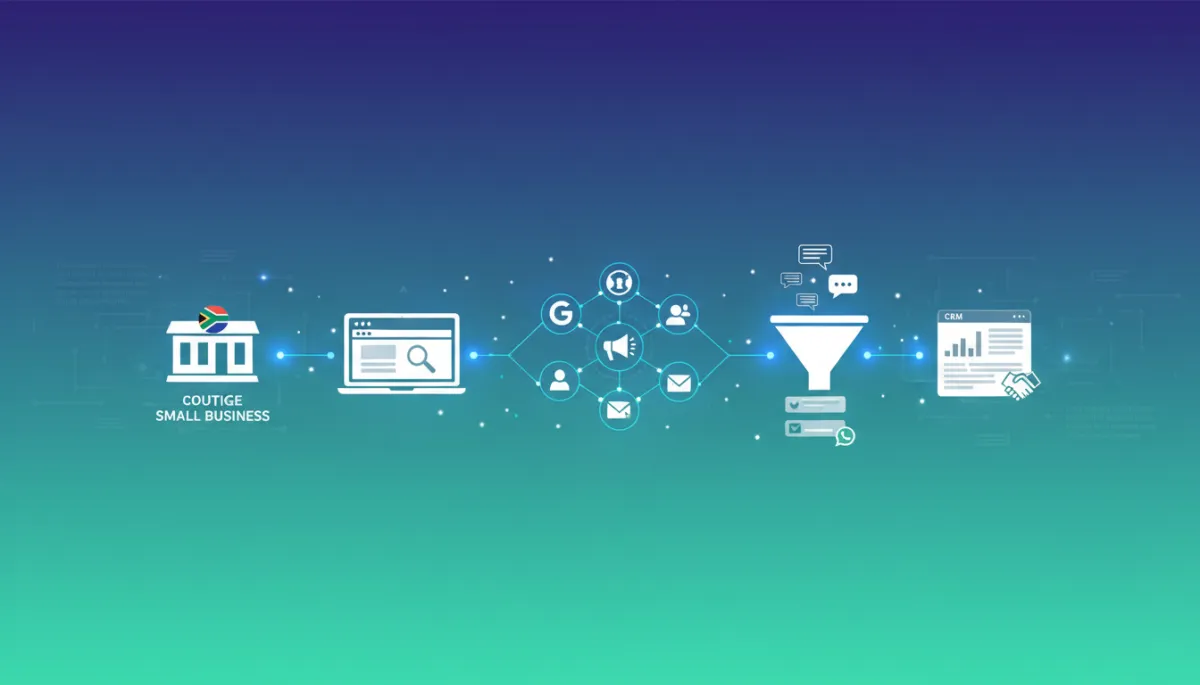
Online marketing is using the internet to attract potential customers, build trust, and convert them into leads and sales through a structured system. It works by driving people to a professional website or landing page, capturing their details via forms or WhatsApp, and following up with CRM, automation, and digital sales processes until they become paying clients.
Traditional Marketing vs Online Marketing: What Has Changed?
Traditional marketing uses offline channels like newspapers, radio, billboards, flyers, and word of mouth. These can still work, but they are often expensive, hard to track, and difficult to target precisely. You pay for exposure, not guaranteed attention or leads, and you usually cannot see exactly which advert produced which customer.
Online marketing, by contrast, happens on digital platforms such as Google, Facebook, Instagram, LinkedIn, email, and your website. You can target specific locations, interests, and keywords, see how many people saw your ad, how many clicked, how many filled in a form, and how many became customers. You move from guessing to measuring, from once-off campaigns to repeatable systems.
💡 Key point: Traditional marketing shouts to everyone. Online marketing speaks directly to the right people and tracks every step from click to sale.
How Online Marketing Works Step by Step
Step 1: Define your offer and ideal customer. What problem do you solve, for whom, and what result do they get? Clear offers convert better than vague promises.
Step 2: Build a professional website or landing page. This is where you send traffic from Google Ads, social media, and email. It explains your services, shows proof, and gives clear next steps, such as “Request a quote” or “WhatsApp us now”.
Step 3: Drive targeted traffic. Use SEO, Google Ads, social media marketing, and online advertising to get the right people to your website when they are actively searching or interested in your service.
Step 4: Capture leads and enquiries. Use enquiry forms, quote request forms, WhatsApp buttons, and click-to-call buttons to collect contact details and questions from interested visitors. This is the start of your lead generation system.
Step 5: Store and manage leads in a CRM. A CRM system keeps all enquiries in one place, tracks follow-ups, and shows where each lead is in your sales funnel, from new enquiry to closed sale.
Step 6: Follow up and nurture with automation. Automated emails, SMS, or WhatsApp messages confirm enquiries, share more information, send reminders, and move people closer to a buying decision, without your team doing everything manually.
Step 7: Convert leads into customers. Your sales team or process closes the deal, sends quotes, books appointments, and turns interest into revenue. You then measure metrics like conversion rate, cost per lead, and lead-to-sale rate to improve over time.
💡 This is where Ukuthula Sales Solutions fits in: we design the website, set up Google Ads, build the lead capture forms, connect your CRM, and automate follow-up so the whole system works together for predictable growth.
Why Your Website Is the Foundation of Online Marketing
Many South African businesses think online marketing is just posting on Facebook or boosting a post. That is not a system. A post disappears in a few hours and often sends people nowhere useful. A professional website is different. It is your digital office, open 24/7, where every campaign sends traffic to a clear, consistent destination.
It explains who you are, what you do, and who you serve in simple language.
It shows proof: customer reviews, case studies, before-and-after photos, and project images.
It gives visitors convenient options: enquiry forms, WhatsApp buttons, click-to-call, and quote request forms.
Your website also connects to your CRM and automation, so every lead is captured, tagged, and followed up. For Ukuthula Sales Solutions clients, this often means a Website Design page explaining services, a Google Ads page explaining traffic generation, a Lead Generation page explaining systems, and a Contact page with strong calls-to-action.
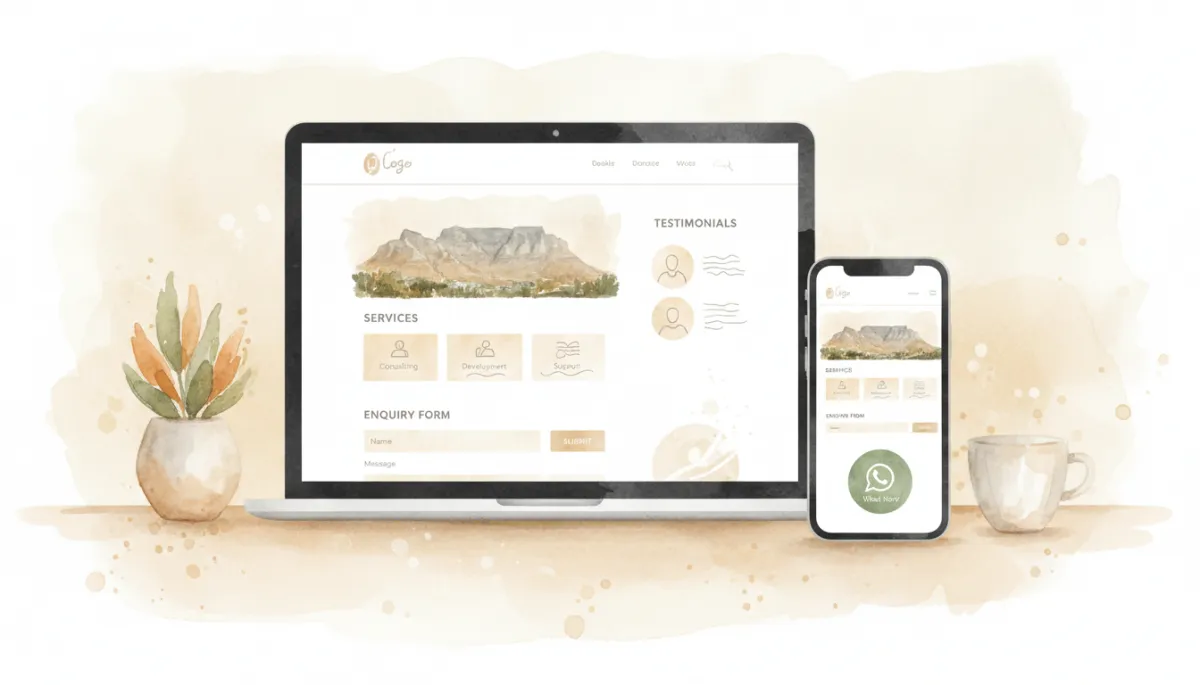
A focused website turns clicks from Google and social media into quality enquiries.
The Main Parts of Online Marketing Explained Simply
1. Websites and SEO (Search Engine Optimization)
Your website is the hub. SEO is the process of improving your website so that it appears higher in Google when people search for services like “plumber in Sandton” or “HR consulting Cape Town”. For South African businesses, this means using local keywords, fast-loading pages, mobile-friendly design, and content that answers real customer questions.
2. Google Ads and Online Advertising
Google Ads is paid online advertising that shows your business at the top of Google when people search for keywords related to your services. You only pay when someone clicks. With proper setup, you can track impressions, clicks, cost per lead, and which keywords bring the most enquiries. This is a core service where Ukuthula Sales Solutions helps clients create profitable campaigns.
3. Social Media Marketing and Content Marketing
Platforms like Facebook, Instagram, and LinkedIn help you stay visible and build trust. Instead of random posts, effective social media marketing shares useful content, before-and-after project images, client testimonials, and short educational tips that link back to your website. Content marketing, such as blog articles and guides, positions your business as the expert and supports both SEO and lead generation.
4. Email Marketing and WhatsApp Enquiries
Email marketing lets you follow up with leads, share updates, and send offers to people who have already shown interest. In South Africa, WhatsApp is also critical. Many people prefer sending a quick WhatsApp message instead of filling in a long form. Adding a clear WhatsApp button on your website, linked to your CRM, improves convenience and response speed, which increases conversions.
5. CRM, Automation, and Lead Generation Systems
Lead generation is not just getting clicks, it is building a system that consistently turns website visitors into qualified leads. A CRM (Customer Relationship Management system) stores every enquiry, tracks follow-ups, and shows your sales pipeline. Automation sends instant confirmations, reminders, and nurturing messages. Ukuthula Sales Solutions specialises in connecting these tools into one digital sales system so no lead is lost or forgotten.
How Online Marketing Builds Attention, Trust, Leads, and Sales
Effective online marketing follows the customer journey from awareness to sale:
Attention: Google Ads, SEO, and social media put your brand in front of people searching or scrolling. Metrics: impressions and clicks.
Interest and trust: Your website content, service pages, blog posts, and visuals explain what you do, show results, and demonstrate professionalism. Metrics: time on site and pages per session.
Enquiry and lead capture: Clear calls-to-action, enquiry forms, WhatsApp buttons, and quote request pages turn visitors into leads. Metrics: form submissions, WhatsApp clicks, phone calls, and quote requests.
Conversion to sale: Your CRM, follow-up, and sales process turn leads into customers. Metrics: conversion rate, cost per lead, and lead-to-sale rate.
Conversion Psychology: Why People Contact a Business Online
People do not enquire just because they see your name. They contact you when several psychological boxes are ticked:
Clarity: They immediately understand what you do, where you operate, and who you help.
Trust and proof: They see Google reviews, testimonials, case studies, and before-and-after examples that show real results for people like them.
Professionalism: Your website looks modern, loads fast, and is easy to use on mobile. Broken pages and outdated designs reduce trust immediately.
Convenience and speed: They can click one button to WhatsApp, call, or request a quote, and they receive a quick, helpful response.
Strong next step: Clear calls-to-action such as “Get a free quote in 24 hours” or “Book a consultation” tell them exactly what happens next.
External credibility signals like a complete Google Business Profile, updated social media pages, listings in trusted directories, and visible customer reviews all reinforce that your business is real, active, and reliable.
Why Everything Must Connect: Offer, Call-to-Action, CRM, and Sales Funnel
Online marketing only works when all parts are connected. Sending paid traffic to a weak page with no clear offer wastes money. Having a good website with no follow-up system wastes leads. A strong digital sales funnel links each stage together:
A clear, valuable offer that solves a specific problem.
A focused landing page or service page with strong visuals and testimonials.
A direct call-to-action: enquire, request a quote, book a consultation, or WhatsApp now.
Lead capture forms and buttons connected to your CRM and automation.
A structured follow-up process and sales pipeline until the deal is closed.
This is exactly the type of marketing system Ukuthula Sales Solutions builds for South African businesses: from Website Design and Google Ads to Lead Generation, Business Automation, CRM setup, and ongoing optimisation.
Practical South African Examples
Consider a plumbing company in Johannesburg. Instead of relying only on word of mouth, they:
Build a simple, fast website with clear service photos, emergency call-out details, and a “Request a call-back in 10 minutes” form.
Run Google Ads for “24 hour plumber Johannesburg” and “blocked drain specialist”.
Add a WhatsApp button for quick emergency enquiries and connect all leads to a CRM.
Or a Cape Town consulting firm. They publish blog articles answering common business questions, share them on LinkedIn, drive traffic to a “Book a strategy session” page, and use email automation to follow up with leads who download a free guide. In both cases, online marketing is a structured system, not random posting.
Visual Optimisation: Making Your Online Presence Look and Feel Trustworthy
Visuals play a major role in conversion. Practical elements that help include:
Professional service photos and project images that show real work you have completed.
Before-and-after examples, especially for trades, renovations, and design-related businesses.
Testimonial blocks with customer names, locations, and star ratings, ideally matching your Google Business Profile reviews.
Clear call-to-action buttons in contrasting colours, such as “Get a quote” or “Schedule a call”.
Screenshot-style visuals of your CRM dashboard, enquiry forms, or review graphics can also reassure potential clients that you operate with structure and transparency.
Actionable First Steps for Beginners
Write down your main offer in one clear sentence and who it is for.
Review your website (or create one) to ensure there is a clear headline, simple service descriptions, visible reviews, and at least one strong call-to-action above the fold.
Claim and complete your Google Business Profile with accurate details, photos, and categories, then start asking happy customers for reviews.
Add a WhatsApp button and a simple enquiry form to your site and make sure enquiries are saved somewhere central, even if it is a basic CRM or spreadsheet to start.
When you are ready, work with a specialist like Ukuthula Sales Solutions to set up Google Ads, refine your lead generation system, and implement automation so your online marketing runs as a predictable business engine.
Frequently Asked Questions About Online Marketing
1. Is online marketing the same as digital marketing?
In everyday business language, yes. Online marketing, digital marketing, and internet marketing all refer to using the internet and digital tools to promote your business, attract leads, and generate sales. The key is having a system, not just isolated activities.
2. How long does it take for online marketing to work?
Paid channels like Google Ads can generate enquiries within days if your website and offer are strong. SEO and content marketing usually take a few months to build momentum. The fastest results come when your website, ads, CRM, and follow-up systems are aligned from the start.
3. Do I need a big budget to start online marketing in South Africa?
No. Many small businesses start with a modest Google Ads budget focused on a few high-intent keywords, combined with a solid website and basic CRM. The goal is to prove the system, measure cost per lead and conversion rate, then scale what works.
4. Is social media enough for my marketing?
Social media alone is not enough. Algorithms change, reach can drop, and posts are short-lived. Social media should support your website and lead generation system, not replace it. Always bring people back to a page you control, where you can capture their details and follow up.
5. Why is a CRM important for online marketing?
A CRM keeps all your leads, enquiries, and customers in one place. It shows who enquired from which channel, who needs a follow-up, and how many leads turned into sales. Without a CRM, it is very easy to lose track of leads and waste your marketing spend.
6. How can Ukuthula Sales Solutions help my business specifically?
Ukuthula Sales Solutions specialises in building complete digital sales systems for South African businesses. This includes professional website development, Google Ads campaigns, lead generation funnels, CRM implementation, and automation. Instead of guessing, you get a structured online marketing system designed to generate predictable enquiries and sales.
Partner With Ukuthula Sales Solutions for a Complete Online Marketing System
Online marketing is no longer optional for South African businesses that want consistent growth. It is the most measurable, scalable way to turn online attention into real enquiries, WhatsApp messages, phone calls, and signed deals. But it only works when your website, Google Ads, SEO, social media, CRM, and automation are connected into one clear system.
Ukuthula Sales Solutions acts as your business growth partner, helping you design and implement that system — from website design and online advertising to lead generation, CRM, and digital sales processes. If you are ready to move beyond random posts and start building a structured online marketing engine, reach out to Ukuthula Sales Solutions today to discuss your website, Google Ads, and digital sales system needs.
