Do I Own My Website and Domain Rights?
Website Ownership, Small Business, South Africa
Do I Own My Website, Domain and Hosting?
If you cannot log in to your domain registrar, your hosting account and your website admin panel, you probably do not fully own your website. You should have your own username and password for each of these, in your name or your company’s name, not only in your developer’s name.
At Ukuthula Sales Solutions, we speak business owners every month who paid for a website, only to find out later that they do not actually control it. The question, “do I own my website?”, is not a technical detail. It is about whether you control a key business asset that brings in enquiries and bookings, or whether someone else can switch it off overnight.
Why website ownership matters for South African businesses
A website that brings you leads is part of your sales machine. If you lose your site, your email stops working or your domain gets taken over, you can lose bookings, long‑term clients and your reputation. During COVID, many agencies and freelancers closed their doors. When debit orders stopped or agencies disappeared, a lot of sites simply went dark. That risk is real, and it is part of the wider picture of website ownership business owners now have to think about.
The three things you must own: domain, hosting and website files
To truly own your online presence, you need control over three layers. If any one of these sits fully in someone else’s hands, you are exposed to website lock‑in in South Africa and you may not even know it.
Your domain name (for example, yourbusiness.co.za), registered at a registrar like Domains.co.za, Afrihost, xneelo or GoDaddy.
Your hosting account, where your website and email live on a server. This could be with a South African host or an international one, but the account should be in your name or your company’s name.
Your website files and CMS login, such as your WordPress admin login, including all the content, images and theme files that make up your site.
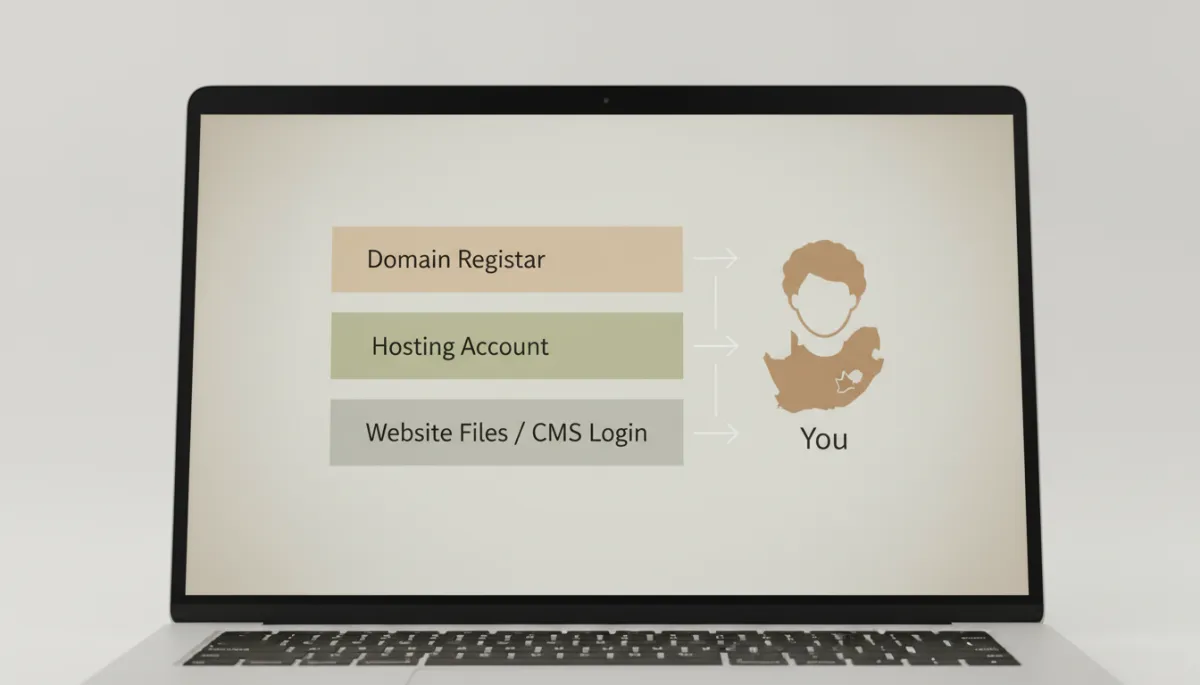
Real control means having your own login to each layer, not only relying on a developer.
A real North West example: when “my” website was never really mine
A guesthouse owner near Hartbeespoort came to Ukuthula after her site went offline without warning. She had been paying a monthly “website package” for years. When she stopped the debit order to cut costs after a quiet winter, her site disappeared. The agency owned the domain, the hosting and the website files. Because it was a rental model, they were not willing to transfer anything. To get back online, she had to register a new domain, rebuild the whole site and start again with Google. That cost her thousands and months of lost enquiries.
In another case, a mining supplier in Rustenburg could not update their own contact details. Their landline number changed, but the original developer had vanished. The domain was registered in the developer’s name, the hosting account was tied to his personal email and no one knew the WordPress admin login. For months, potential clients were phoning a dead number. That is not only frustrating, it is lost revenue.
What “website rental” or monthly subscription really means
Many South African agencies sell “R499 per month websites” or similar. Often, this is not a payment plan for a site you will own. It is a rental. The agency owns the domain, the hosting and the website. You are renting the use of that site for as long as you keep paying the monthly fee. When you stop, the site normally goes down and you cannot take it with you.
There is nothing wrong with a rental model if you understand it and accept that you are paying for convenience, not ownership. The problem is when a business owner thinks they are buying a permanent asset, but the contract says otherwise. That misunderstanding is at the heart of many painful stories about website lock‑in South Africa.
DIY builders and platform lock‑in: Wix, Squarespace and others
If you build your own site on Wix, Squarespace or similar DIY tools, you are making a clear choice to rent space on their platform. You own your content, your images and your text, but you do not own the platform design or the system it runs on. You cannot export a Wix site and move it to another host. You would need to rebuild the design elsewhere.
For some owners, this is perfectly fine. If you know your website is a rental and you are happy with that, this concern is not for you. You are making an informed decision. The real risk is for owners who think they have bought a permanent website, when in fact they are on a subscription that can disappear when payments stop.
Who owns my domain? The South African .co.za context
.co.za domains are part of the .za namespace, which is regulated under the Electronic Communications and Transactions Act, 2002. The .ZA Domain Name Authority (ZADNA) oversees policy, and the ZA Registry Consortium (ZARC) operates many of the registries for .co.za and similar domains. You do not register directly with ZADNA or ZARC. You register through an accredited registrar such as Domains.co.za, Afrihost, xneelo or others, who in turn work with the registry operator. (Source: ZADNA, zadna.org.za; ZARC, zarc.web.za.)
In that system, the key name is the registrant. That is the legal holder of the domain. To protect your business, the registrant should be you or your company, not your designer or agency. If the registrant is your developer, they can block transfers or even point the domain somewhere else if the relationship breaks down. While there are dispute processes under South African law, they take time and effort. It is far easier to get this right from the start.
How to check who owns your domain in practice
You can check who owns your domain by using a WHOIS lookup tool. Sites like who.is or the Domains.co.za WHOIS search show details about the registrant, registrar and contact email for many domains. Some information can be hidden for privacy, but you should still be able to confirm that the registrant name and contact email are yours or your company’s, not your developer’s personal details.
💡 Pro Tip: If your developer says “do not worry, it is easier if I put the domain in my name”, insist that the registrant is you and that they are listed only as the technical or administrative contact.
Website hosting ownership: who controls the server and backups?
Hosting is where your site and email live. In South Africa, providers like xneelo, Afrihost, HostAfrica and others offer shared and managed hosting. Market data shows xneelo with about 45.7% share and Afrihost around 22.85 percent, which gives a sense of how central these services are to local businesses. (Source: hostings.info, South Africa hosting market share.)
Owning your hosting does not mean you own the physical server. It means the hosting account is in your name, you pay the provider directly and you have your own login to the control panel, such as cPanel or a custom dashboard. Your developer can still manage things for you, but you are not locked out. If you decide to move to another host, you can ask for backups or migrate the site without begging anyone for access.
What you should receive at handover from a professional web developer
When a website project is finished, you should receive a clear handover pack. At Ukuthula, our website design clients receive a simple document with all the access details they need. Any professional provider should give you at least the following:
Login credentials for the domain registrar, with your domain registered in your or your company’s name.
Login details for the hosting control panel, such as cPanel or the host’s own dashboard.
Admin login for the CMS, such as WordPress, including a secure email address where password resets go to you, not to the developer.
A backup of the website files and database, or clear instructions on how to generate one.
Access to key tools such as Google Analytics, Google Search Console and any email marketing platforms linked to the site.

A proper handover gives you control while still allowing your developer to support you.
Red flags that you do not own your site
The developer says “we manage everything” but refuses to give you any login details.
Your domain is registered in the developer’s personal name, not your business name.
You cannot access your own Google Analytics or Search Console accounts.
Your contract talks about a “monthly website service” with no mention of transfer or ownership if you cancel.
You have no idea which hosting company you are with, or what plan you are on.
📌 Key Takeaway: If you cannot move your website, domain and email to another provider without your current developer’s permission, you are not in full control.
COVID lessons: when agencies close, websites disappear
When lockdowns hit, many South African small agencies and freelancers closed. Monthly retainers stopped, debit orders bounced and many websites that were tied to those businesses went offline. In a market where local hosts like xneelo and Afrihost support thousands of SMEs, that disruption showed how fragile things can be when ownership is not clear. The ECT Act and ZADNA policies provide a framework for domain disputes, but they do not fix a missing backup or a lost CMS login. Prevention is still better than cure.
Who this concern is not for
If you are on a DIY builder like Wix or Squarespace and you know you are renting a platform, this concern is different for you. You understand that if you stop paying, the site will go offline and that you cannot export the design. You are making a trade‑off between control and simplicity, and that is fine if it is a conscious choice.
The real problem is when a guesthouse in Brits or a hunting safari operator near Rustenburg believes they own a website as a long‑term asset, but in the fine print it is a rental and they have no rights to move it. That is where clear information and honest contracts matter.
What Ukuthula Sales Solutions does differently
Ukuthula works with hospitality businesses, hunting safaris, mining and industrial suppliers and retail clients across the North West and wider South Africa. Our focus is simple: build websites that bring in leads, and make sure clients truly own those sites. That is why our process is built around ownership from day one.
We register domains in the client’s name, with the business as the registrant, not Ukuthula.
We set up hosting accounts that the client can access directly, with their own billing details.
We build on platforms like WordPress or GoHighLevel where you can move your site to another host if needed and if platforms allow transfer!
We hand over all logins in writing and keep a secure copy as part of our website support service if you want ongoing help.
Our support is optional. You are not locked into a long‑term rental. If you decide to move to another provider in future, you should be able to do so without losing your domain, your email or your hard‑won Google rankings.
FAQ: Website ownership for South African small businesses
1. How do I know if I really own my website?
Check whether you have your own login for the domain registrar, hosting account and website admin panel. Use a WHOIS lookup to confirm that the registrant for your .co.za domain is you or your business. If everything runs through your developer’s personal accounts and they refuse to share access, you do not have full ownership.
2. What happens to my site if I stop paying a monthly website subscription?
In most rental models, the site goes offline and you cannot take the design or code with you. Some providers may let you buy the site out for a fee, but many will not. Always ask in writing what happens if you cancel, and whether you can move your site to another host.
3. Is it safer to host my site in South Africa?
Local hosting with providers like xneelo or Afrihost offers good performance for South African visitors and can make POPIA compliance and data jurisdiction simpler, since your data stays in the country. International hosts can also work well, but you should check where your data is stored and what the contract says about backups and data access. POPIA section 72, for example, sets rules for personal data leaving South Africa.
4. Can my developer register the domain in their name and transfer it later?
Technically, yes, they can, but it is risky for you. If the relationship breaks down or the developer disappears, you could face a long process to recover the domain through the registrar or ZADNA’s dispute channels. It is far better to have the domain in your name from the start, with your developer listed only as a technical contact if needed.
5. I am on Wix or Squarespace. Do I own my website?
You own your content and your domain if you registered it in your name, but you do not own the platform. If you leave, you cannot export the full design and site structure. You would need to rebuild it on another system. If you are happy with that trade‑off and understand it, that is a conscious choice, not a hidden risk.
6. Can Ukuthula help me regain control of my existing site?
In many cases, yes. We can help you check your domain ownership, contact your current host, secure backups where possible and plan a safe move to a setup where you have full access. If your current site is locked into a rental model, we can rebuild it in a way that you own, using our website design and support services.
Take back control of your website asset
Your website, domain and hosting are not just technical items. They are part of how your business anywhere in South Africa or USA finds new clients. When you treat them as assets you own, not as a mystery handled by “the web guy”, you reduce risk and gain options. You can change providers without losing everything, you can update your own details and you can sleep better at night.
At Ukuthula Sales Solutions, every website project ends with a full ownership handover. You get the logins, the documentation and the support you need, without being locked into a contract you cannot leave. If you are unsure about your current setup or you want a new site that you truly own, contact Ukuthula today to review your website ownership and plan a design and support package that keeps you in control.
