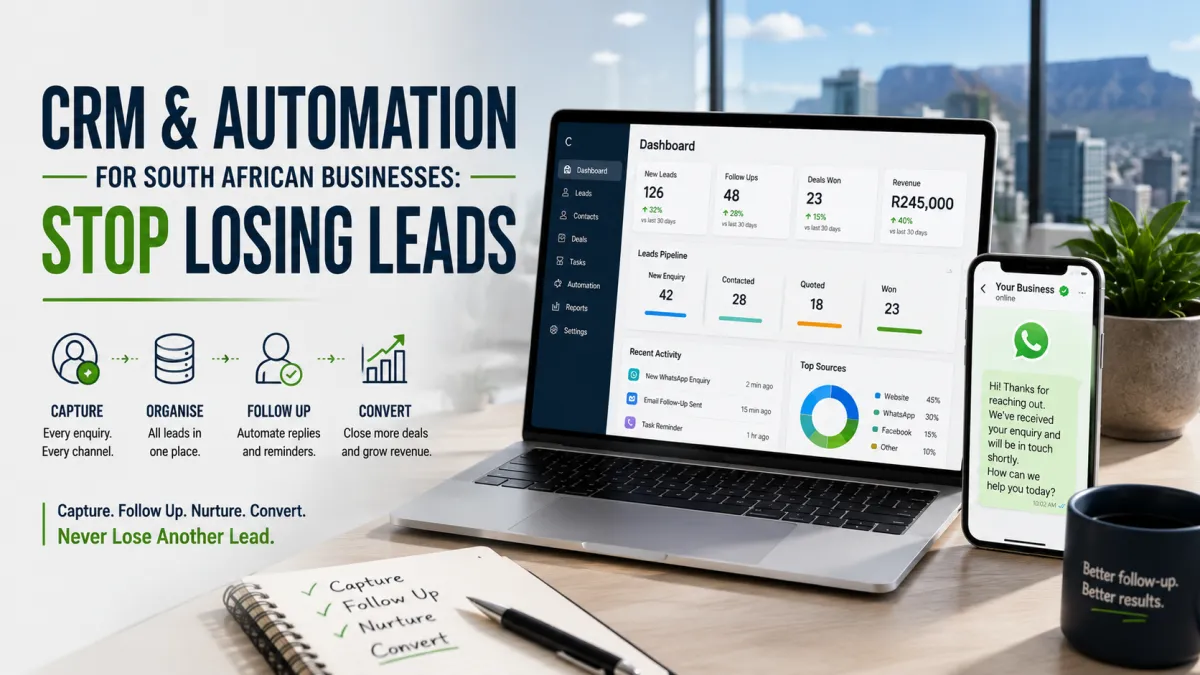
CRM & Automation for South African Businesses: Stop Losing Leads
CRM, Business Automation, Lead Management
A CRM, or Customer Relationship Management system, is a central tool that captures every enquiry your business receives, stores it in one organized place, and tracks each lead from first contact until the sale is closed. Combined with automation, it ensures no enquiry is forgotten, every prospect is followed up quickly, and no revenue slips through the cracks, which is the single biggest cause of lost sales for South African businesses.
What Is a CRM and How Does It Stop Lost Leads?
A CRM stops lost leads by giving every enquiry a home and every follow-up a schedule. When a customer fills in a form, sends a WhatsApp, or calls, their details are captured automatically and stored in one system rather than scattered across a phone, an inbox, and a notebook. The CRM then tracks where each lead sits in your sales process and reminds your team to follow up, so no enquiry is ever left to go cold.
Most South African businesses do not lose sales because of poor marketing. They lose sales because enquiries arrive faster than they can be handled, get forgotten, or are followed up too slowly. A CRM removes that leak by turning scattered, easily-forgotten enquiries into an organized, trackable pipeline.
Why South African Businesses Lose Leads Every Day
Lost leads usually come from a lack of system, not a lack of effort. A business owner juggling quotes, jobs, and admin simply cannot manually track every enquiry across every channel. The most common causes are predictable and fixable.
Slow follow-up. A lead that waits hours for a reply has often already contacted a competitor.
Scattered enquiries. Messages spread across WhatsApp, email, Facebook, and phone calls are easy to miss.
No tracking. Without a record of who enquired and when, follow-ups are forgotten.
No reminders. Busy owners intend to follow up "later" and never do.
No nurturing. Prospects who are not ready to buy today are lost instead of kept warm.
Each missed enquiry is money already spent on marketing that never turns into revenue. Plugging this leak is often more profitable than spending more on ads.
How a CRM Works, Step by Step
A CRM works as a structured journey that moves every lead from first contact to closed sale without anything falling through the cracks. It brings order to what is otherwise chaos.
Capture. Every form, WhatsApp message, and call is recorded automatically in one place, with the lead's details and source.
Store. All leads sit in a single organized database instead of scattered across apps and devices.
Track. Each lead is tagged with its stage, such as new enquiry, quoted, or won, so you always know where it stands.
Follow up. The CRM reminds your team to act, or triggers automated messages, so no lead waits too long.
Convert and measure. Closed deals are recorded, and you can see which sources and campaigns produce paying customers.
This structure means a lead is never dependent on someone remembering it. The system carries the memory, and the team carries the relationship.
What Business Automation Actually Does
Automation is the layer that handles routine follow-up instantly and consistently, without your team doing it manually. It responds faster than any human can and never forgets a step, which dramatically improves both speed and reliability of follow-up.
Instant replies. A new enquiry receives an immediate WhatsApp, SMS, or email confirmation, so the customer knows they have been heard.
Follow-up sequences. Automated messages share more information and gently remind prospects to respond over the following days.
Task reminders. The system tells your sales team exactly who to call and when.
Nurturing. Leads who are not ready to buy receive periodic updates and offers until the timing is right.
Re-engagement. Past customers are reminded of renewals, services, or new offers automatically.
In South Africa, where many customers prefer WhatsApp over email, automation that sends an instant WhatsApp reply the moment someone enquires can be the difference between winning the job and losing it to a faster competitor.
Manual Follow-Up vs Automated Follow-Up
The gap between manual and automated follow-up is the gap between losing leads and closing them. Manual follow-up depends on memory and available time; automated follow-up happens every time, instantly, regardless of how busy the team is.
Automation does not replace the personal relationship that closes a sale. It removes the admin that causes leads to be lost, freeing your team to focus on the human conversations that actually win business.
Building a Lead-Management System That Works
A reliable lead-management system connects every enquiry channel to one CRM and one automated follow-up flow. Building it follows a clear sequence.
Connect all channels. Link your website forms, WhatsApp, and phone enquiries so every lead flows into one system.
Set up automated confirmation. Ensure every new enquiry receives an instant reply acknowledging their message.
Define your pipeline stages. Map the journey from new enquiry to closed sale so every lead has a clear status.
Create follow-up sequences. Build automated message sequences that nurture leads who do not respond immediately.
Add task reminders. Set the system to alert your team when a personal call or quote is needed.
Track sources. Tag every lead with where it came from, so you know which marketing produces sales.
Ukuthula Sales Solutions builds this exact system for South African businesses through its Business Management System service, connecting website, WhatsApp, and ads to a CRM with automation so every enquiry is captured, answered, and followed up.
Signs Your Business Needs a CRM Now
Certain symptoms show clearly that manual lead handling has reached its limit. If several of these sound familiar, a CRM will pay for itself quickly by recovering leads you are currently losing.
You have caught yourself forgetting to follow up on an enquiry.
Leads come through WhatsApp, email, and calls with no single record.
You cannot say how many enquiries you received last month or where they came from.
Follow-up depends on whether someone remembers, not on a system.
You are spending on marketing but unsure which channel produces customers.
Enquiries sometimes wait hours or days for a first response.
Any one of these is a leak. Several together mean your business is likely losing a meaningful share of the leads your marketing already paid to generate.
How CRM Connects Your Website and Google Ads into One System
A CRM is most powerful when it sits at the center of your whole marketing system, catching every lead your website and ads produce. Your Google Ads generate clicks, your website turns clicks into enquiries, and your CRM ensures those enquiries become customers through fast, tracked follow-up.
Without a CRM, money spent on Google Ads and website design leaks away at the final step, because enquiries arrive but are not converted. With a CRM, the whole system becomes measurable and profitable. Ukuthula Sales Solutions connects Website Design, Google Ads, and the Business Management System so the entire journey from click to customer runs as one predictable engine.
Frequently Asked Questions About CRM and Automation
1. What is the difference between a CRM and automation?
A CRM is the system that stores and organizes your leads and customers, while automation is the layer that sends follow-up messages and reminders without manual effort. They work best together: the CRM holds the information, and automation acts on it instantly. Alone, each is useful; combined, they form a complete lead-management engine.
2. Is a CRM only for big businesses?
No. Small businesses often benefit more, because they lose a larger share of their leads to slow or forgotten follow-up. A CRM lets a small team handle far more enquiries without dropping any, which levels the field against larger competitors. The system does the remembering so a busy owner does not have to.
3. How does automation help with WhatsApp enquiries?
Automation can send an instant WhatsApp confirmation the moment someone enquires, so the customer knows their message was received. It can then follow up with more information and reminders automatically. In South Africa, where WhatsApp is a primary channel, this speed often wins the job before a slower competitor even replies.
4. Will automation make my business feel impersonal?
Used correctly, automation handles the routine parts like confirmations and reminders, which frees your team to have more personal conversations where they matter. Customers experience faster responses, not colder ones. The goal is to remove admin, not the human relationship that closes the sale.
5. How quickly can a CRM start recovering lost leads?
A CRM starts capturing and tracking every enquiry from the day it goes live, so leads stop falling through the cracks immediately. The follow-up improvements show quickly, often within the first weeks, as enquiries that would previously have been forgotten are now answered and converted.
6. Can a CRM tell me which marketing is working?
Yes. By tagging every lead with its source, a CRM shows exactly how many enquiries and sales came from Google Ads, your website, or social media. This turns marketing from guesswork into measured decisions, letting you invest more in what produces customers and cut what does not.
Stop Losing Leads with Ukuthula Sales Solutions
Every enquiry your business loses is money your marketing already paid to generate. Slow follow-up, scattered messages, and forgotten leads quietly drain revenue that a proper system would capture. A CRM combined with automation closes that leak, ensuring every lead is recorded, answered instantly, and followed up until it becomes a customer.
Ukuthula Sales Solutions builds this complete lead-management system for South African businesses, connecting your website, WhatsApp, and Google Ads to a CRM with automated follow-up through its Business Management System service. If you are ready to stop losing leads and start converting more of the enquiries you already receive, reach out to Ukuthula Sales Solutions today
