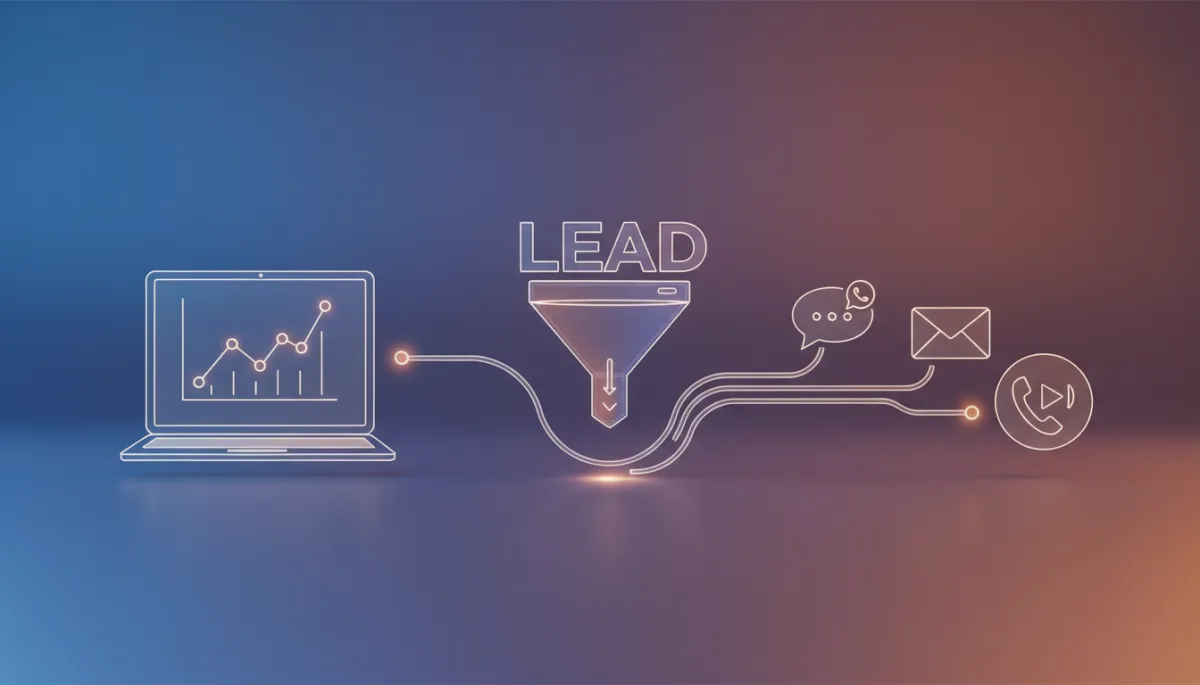
Boost Leads with Effective Website Design
Lead Generation, Website Design South Africa, Digital Marketing
How Can My Website Bring In More Leads?
Your website brings in more leads when it is built as a lead generation system, not an online brochure. That means attracting the right visitors, explaining your offer clearly, building trust with proof, making it easy to contact you, and connecting every enquiry to a proper follow-up process, CRM, and automation.
Featured answer: how your website can bring in more leads
A website brings in more leads by combining targeted traffic with conversion-focused design. It attracts the right visitors through SEO and Google Ads, builds trust with clear messaging and proof, uses strong calls-to-action, WhatsApp buttons, and enquiry forms, and connects every interaction to CRM, automation, and a structured sales funnel for follow-up.
Your website is not a brochure – it is a sales tool
Many South African businesses still treat their website as a digital company profile. It looks neat, lists services, and shares contact details, but it does not actively generate new opportunities. A brochure waits to be read. A lead generation website is designed to start conversations, book calls, and create quote requests every day.
At Ukuthula Sales Solutions, we build business websites to function like an online sales rep that works 24/7. It attracts the right people, answers their key questions, gives them confidence, and then guides them to enquire via phone, WhatsApp, form, or email, while your CRM and automation handle the follow-up in the background.
Normal website vs. lead generation website
Normal website: Focuses on appearance, company history, and generic content. Visitors must figure out what to do next. There is often one small “Contact Us” link and little tracking of results.
Lead generation website: Focuses on clarity, trust, and action. Every key page has clear messaging, visible calls-to-action, WhatsApp buttons, enquiry or quote request forms, and tracking to measure conversion rate and cost per lead.
The difference is not only design. It is strategy. A lead generation website is built around your sales funnel: awareness, interest, trust, enquiry, and follow-up until sale. Each step is planned, measured, and improved over time.
Attracting the right visitors: SEO, Google visibility, and Google Ads
A website that gets leads starts with the right traffic. You do not just need more visitors. You need people who are actively looking for your services in South Africa and are ready to take the next step. That is where SEO and Google Ads work together with your website design South Africa strategy.
SEO and Google visibility: Service pages and blog content should target phrases like “plumber in Sandton,” “tax consultant Cape Town,” or “lead generation website for small business.” This helps your website appear for high-intent searches.
Google Ads campaigns: A well-structured Google Ads website campaign sends paid traffic to focused landing pages, not your generic homepage. These landing pages are designed purely for conversion, with one clear action: call, WhatsApp, or request a quote.
💡 Pro Tip: If you are running Google Ads but sending traffic to a slow, confusing homepage, you are paying for clicks that do not turn into leads. Optimise the landing page first, then increase your budget.
Traffic is not enough: why conversion matters more than visits
Many business owners focus on website visits and forget about conversion. A thousand people can visit your business website, but if only one person submits an enquiry, your website conversion rate is weak, and your cost per lead is high. The goal is not visitors. The goal is enquiries, WhatsApp messages, phone calls, and booked meetings.
Conversion-focused websites make it easy for visitors to act. They use strong, repeated calls-to-action, visible buttons, and simple forms. They remove friction and answer doubts before the visitor leaves. That is how you turn traffic into measurable opportunities instead of “website traffic” that never becomes revenue.
Clear messaging: say exactly who you help and what you do
When someone lands on your homepage, they decide within a few seconds if they are in the right place. Clear messaging is your first conversion tool. A lead capture website answers three questions immediately:
Who do you help? (e.g., small businesses in Johannesburg, homeowners in Durban, SMEs across South Africa)
What problem do you solve? (e.g., reliable plumbing, tax compliance, professional website design, digital marketing South Africa)
What should they do next? (call, WhatsApp, request a quote, book a consultation)
💡 Quick action: Rewrite the main heading on your homepage to say exactly who you help and what you deliver, then place a clear “Get a Quote” or “Request a Call Back” button directly beneath it.
Strong calls-to-action, WhatsApp buttons, and enquiry forms
Visitors become leads when you clearly tell them what to do and make it effortless. A high-converting small business website in South Africa typically includes:
Prominent call-to-action buttons such as “Get a Free Quote,” “Book a Consultation,” or “Chat on WhatsApp,” repeated across the page.
Click-to-WhatsApp buttons that open a pre-filled message, ideal for mobile visitors who prefer quick chats over forms or emails.
Short enquiry and quote request forms that ask only for essential details: name, contact, service required, and location. The shorter the form, the higher the completion rate.
For example, a Pretoria-based security company might use a landing page with a headline like “Professional CCTV Installation for Gauteng Homes and Businesses,” followed by a three-field quote form and a WhatsApp button. Every click and form submission is tracked as a lead in their CRM and measured against ad spend.
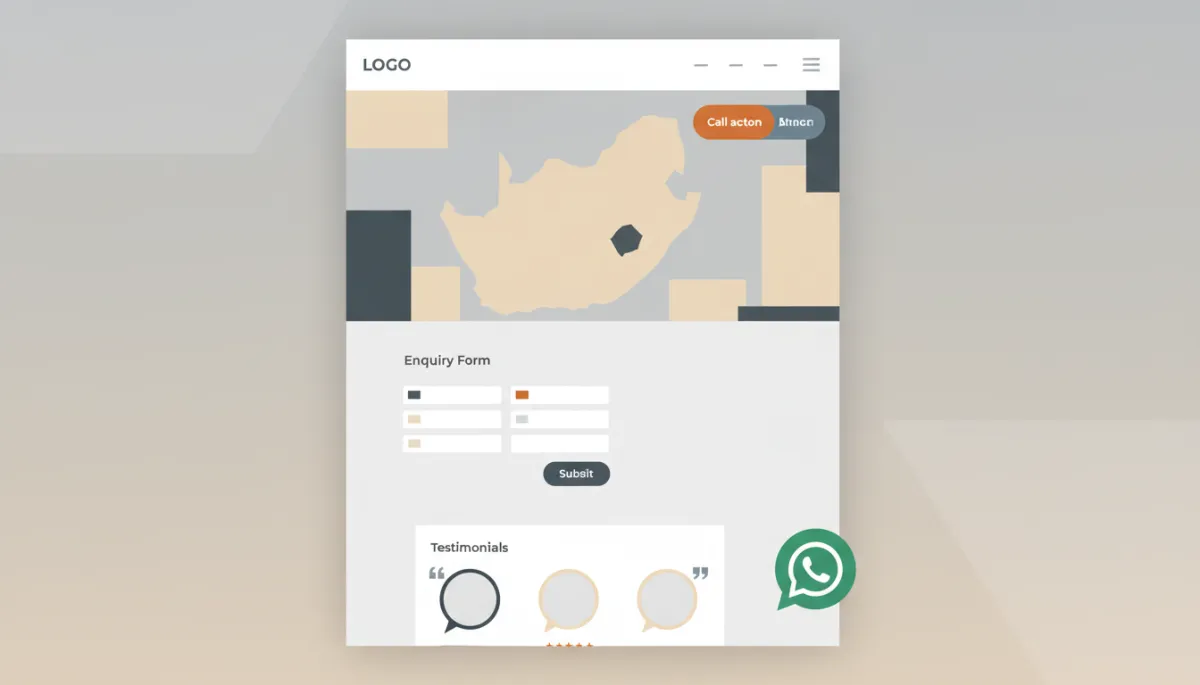
-toned screenshot-style layout showing a South African service business website with clear...
Simple calls-to-action, WhatsApp buttons, and short forms consistently increase website enquiry rates.
Service pages, landing pages, and UX flow that guide visitors
A strong lead generation website does not rely on one generic page. It uses focused service pages and landing pages for each main offer. This improves SEO, Google Ads relevance, and user experience (UX flow), because visitors see exactly what they searched for and feel understood.
Service pages: One page per core service, with clear benefits, pricing guidance, FAQs, testimonials, and a contact or quote form. This is ideal for internal linking from your homepage and blog posts.
Landing pages: Dedicated pages for campaigns like “Google Ads management,” “website design South Africa,” or “solar installation quotes.” Each page is built purely for conversion and used in Google Ads and social campaigns.
The ideal UX flow is simple: visitor lands on a relevant page, quickly understands your offer, sees proof, and is guided to enquire. No unnecessary clicks, no confusion, no dead ends. Internal links to related services, case studies, and your contact page support this journey without distracting from the main call-to-action.
Trust, proof, and conversion psychology: why people decide to enquire
People become leads when they trust you enough to share their details. Conversion psychology shows that trust is built through clarity, proof, and low risk. Your website should answer, “Can I trust this business with my money, time, and data?”
Clarity reduces anxiety: Clear copy, pricing guidance, and step-by-step explanations reduce uncertainty and make it easier to act.
Social proof builds confidence: Testimonials, Google reviews, case studies, and logos of clients or associations show that others trust you already.
Low-friction contact options: Quick WhatsApp chats, short forms, and clear response times (“We respond within 1 business hour”) make the next step feel safe and easy.
For example, a Cape Town accounting firm could show a photo of the team, a short video explaining their process, screenshots of SARS compliance certificates, and Google review graphics. Combined with a clear “Request a Tax Consultation” button, these visual and written cues work together to convert visitors into leads.
Visual optimisation: photos, proof, and clear design
Visuals are not just decoration. They influence how professional and trustworthy your business feels. A lead generation website uses visuals strategically:
Service photos and project images showing real South African locations, teams, and equipment.
Before-and-after examples for industries like construction, renovations, landscaping, and web design.
Testimonial sections, review graphics, and screenshots of Google Business Profile ratings or directory listings.
Clear, contrasting call-to-action buttons and well-placed enquiry forms on every key page.
External credibility: Google Business Profile, reviews, and directories
Your website does not stand alone. External platforms strongly influence whether a visitor decides to contact you. A professional lead generation website integrates and highlights these signals:
Google Business Profile: Ensure your profile is verified, updated, and linked to your website. Show your star rating and review count on your site for extra trust.
Reviews and testimonials: Display real names, locations, and, where possible, photos. Link to your Google reviews or credible directories like local business listings.
Social profiles: Link to active, professional social accounts to show that your business is real, current, and responsive.
CRM, automation, and sales funnels: what happens after the enquiry
A website that gets leads is only the first stage. To turn those leads into paying customers, you need a follow-up system. This is where CRM, automation, and sales funnels become essential business tools, not just marketing buzzwords.
CRM integration: Every form submission, WhatsApp click, or call enquiry should create or update a contact in your CRM, with the source (e.g., Google Ads, organic search, Facebook) recorded for reporting.
Automation: Automated emails or WhatsApp messages can confirm receipt, share next steps, and follow up with leads who have not responded yet, improving your lead-to-sale rate.
Sales funnel tracking: Measure how many visitors become leads, how many leads become quotes, and how many quotes become sales. This allows you to improve weak points, not just guess.
💡 Practical example: A Johannesburg solar installer connects their website forms to a CRM. Each new enquiry triggers an automatic email, a WhatsApp follow-up, and a task for the sales team. Their response time drops, and their conversion rate from lead to sale improves significantly.
Metrics that matter: how to know your website is working
To treat your website as a serious business asset, you must measure its performance. Useful metrics include:
Website visits and where they come from (organic, Google Ads, social, referrals).
WhatsApp clicks, form submissions, and phone call clicks from the website.
Conversion rate (leads divided by total visitors) for each landing page.
Cost per lead from Google Ads and other campaigns.
Lead-to-sale rate in your CRM, so you know your true return on investment.
Quick actions you can take today
Add a clear, benefit-focused headline and strong call-to-action to your homepage hero section.
Place a WhatsApp button and a short enquiry form on every key service page.
Add at least three recent testimonials with names, locations, and, if possible, review screenshots from your Google Business Profile.
Create separate service pages for your main offerings and link to them clearly from your homepage navigation.
Start tracking website enquiries, WhatsApp clicks, and phone calls so you can see your current conversion rate.
FAQ: turning your website into a lead generation system
Below are common questions South African business owners ask when they want their website to generate more leads, not just views.
1. How can my website bring in more leads without increasing traffic?
Focus on conversion. Improve your messaging, add strong calls-to-action, make enquiry forms and WhatsApp buttons more visible, and add trust elements like testimonials and reviews. Often, redesigning key sections of your existing site and simplifying the user journey can significantly lift your enquiry rate without more visitors.
2. Do I need Google Ads if I already rank on Google?
Organic SEO is valuable, but Google Ads lets you target high-intent keywords immediately and test landing pages quickly. Many successful South African businesses use both: SEO for long-term visibility and Google Ads for predictable, controllable lead generation that can be scaled up or down as needed.
3. What is the difference between a landing page and a normal page?
A landing page is built for one specific campaign and one main action, such as requesting a quote. It removes distractions like complex menus and extra links. A normal page may include broader information, navigation, and multiple possible actions. For paid campaigns, a focused landing page almost always converts better.
4. How important is a CRM for small businesses in South Africa?
A CRM is essential if you want to grow consistently. It centralises your leads from your website, Google Ads, social media, and referrals, and helps you track follow-ups, quotes, and deals. Even a small team can manage more opportunities, respond faster, and measure lead-to-sale rates when a CRM is connected to the website.
5. How do I know if my website design is hurting conversions?
Warning signs include low enquiry numbers despite good traffic, slow loading times, cluttered layouts, hard-to-find contact details, and forms that ask for too much information. If visitors must scroll or click several times to find a call-to-action, your design is likely limiting your lead generation potential.
6. Can Ukuthula Sales Solutions help with both the website and the follow-up system?
Yes. Ukuthula Sales Solutions specialises in professional website design, lead generation systems, Google Ads campaigns, CRM setup, automation, and digital sales funnels for South African businesses. We focus on the complete journey, from the first click on your website to the final sale and beyond.
Turn your website into a lead generation asset with Ukuthula Sales Solutions
If your current website feels like an online brochure, you are leaving leads and revenue on the table. A modern lead generation website should attract the right visitors, build trust quickly, make contact effortless, and feed every enquiry into a structured follow-up system with CRM and automation in place.
Ukuthula Sales Solutions partners with South African businesses to design and build websites that work as real sales tools, supported by Google Ads, digital marketing, and integrated sales processes. If you want a website that consistently brings in more leads, not just more clicks, it may be time to upgrade your digital sales system.
Reach out to Ukuthula Sales Solutions to discuss your current website, your lead generation goals, and how a connected website, CRM, and automation setup can help you turn online visitors into reliable, measurable sales opportunities.
